
“You think your pain and heartbreak are unprecedented in the history of the world, but then you
read.”
These words first drew me into James Baldwin’s world during the confusing early days of the COVID-19 pandemic, set against the backdrop of the global resurgence of the Black Lives Matter movement in 2020. At a time when isolation, grief and anger felt overwhelming, Baldwin’s writing offered something grounding: the reminder that suffering has history, context and meaning, and that we are never alone in it.
Years later, opening my inbox to find an invitation from NYJO to join a project celebrating Baldwin’s centenary felt strangely full circle. I jumped at the opportunity to be part of a curation that already felt deeply meaningful to me. The application process itself was simple enough: a few questions about my interest in the project, what I felt I could bring to it, and what I hoped to gain.
At the time, I had no sense of the depth of exploration this project would demand, nor of the personal resonance it would come to hold.
James Baldwin was an informed, articulate and unflinching voice within the African American community, a cultural landscape from which so many musical genres have emerged: gospel, soul, rhythm and blues, and of course, jazz. In his essay The Uses of the Blues, Baldwin opens with the striking admission, “I don’t know anything about music.” What follows, however, is not a dismissal of music, but a profound understanding of its purpose. He describes the blues as a response to lived experience, stating that they “contain the toughness that manages to make this experience articulate.” He references the work of Billie Holiday and Bessie Smith, artists whose music gave voice to their humanity while laying bare the injustices that shaped it. Baldwin also draws a sharp comparison between Harry Belafonte and Frank Sinatra, exposing the limits of success in a racially unequal society.
“The fact that Harry Belafonte makes as much money as, let’s say, Frank Sinatra, doesn’t really mean anything in this context. Frank can still get a house anywhere, and Harry cant’. This has nothing to do with Harry; this has everything to do with America.”
Despite claiming he knew nothing about music, Baldwin clearly understood the role of artists as witnesses and truth-tellers. His extensive collaboration with Nina Simone, most notably on A Raised Voice, which combined her music with his writings and speeches, demonstrates his belief in art as a vehicle for honesty, resistance and social reflection.
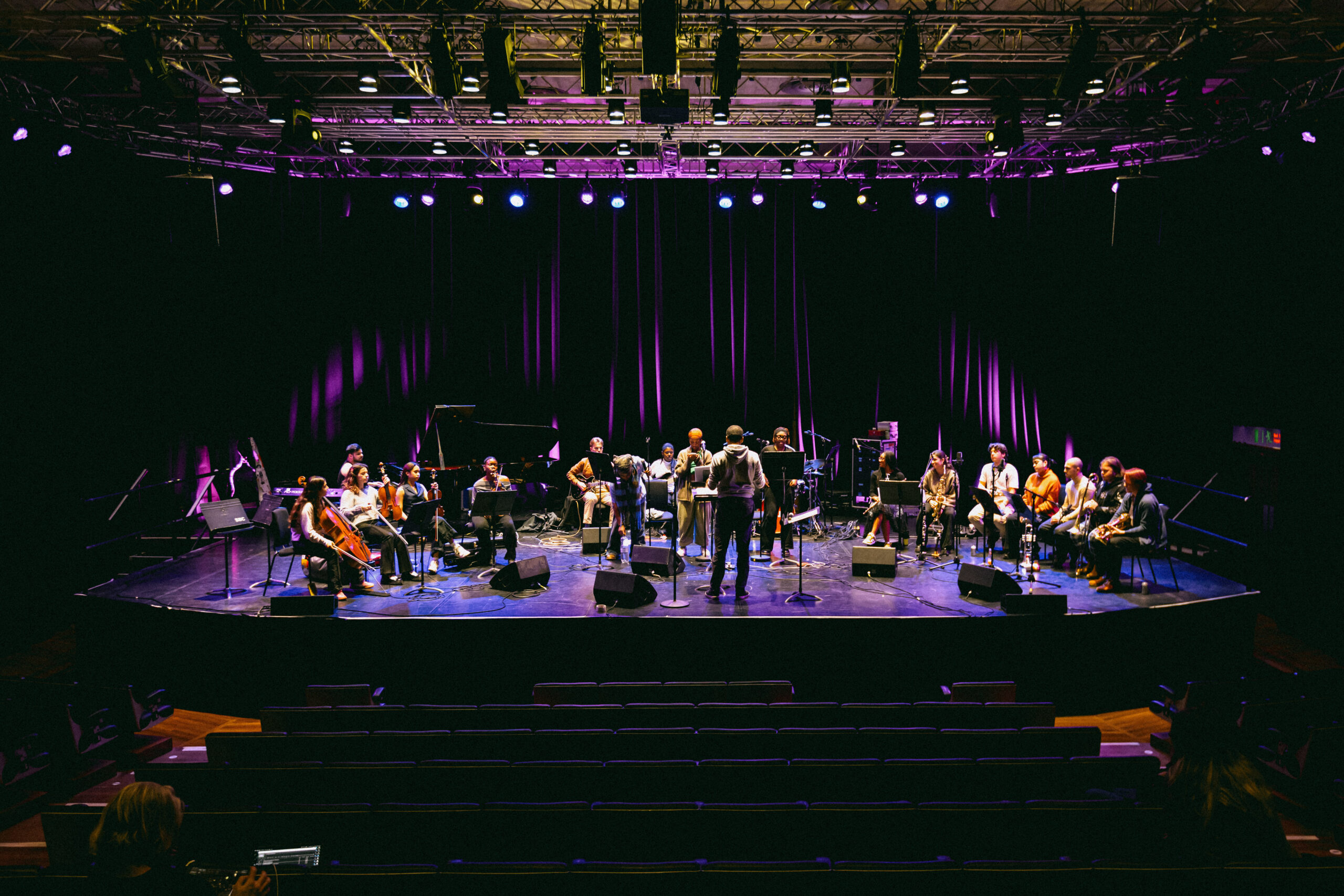
The NYJO project, eventually titled The Fire Next Time, was led by Associate Musical Directors Peter Edwards and Lucy-Anne Daniels. Lucy-Anne’s extensive research into Baldwin’s life and work, particularly his relationship with music, provided a strong foundation for our process. Our research and development days encouraged us to reflect on how we had encountered Baldwin previously, if at all, and to examine our emotional responses to his writing, speeches and the facts of his life. These sessions were as much about self-reflection as they were about research. Gradually, we began to identify the themes that felt most central to Baldwin’s legacy and most urgent to explore musically: identity, sexuality, race relations and religion.
When it came time to pick up my violin, these themes were swirling around my mind with very little sense of how they might translate into sound. Baldwin had spent a lifetime refining his language in order to articulate the human experience. I found myself questioning how those ideas could possibly be communicated through the wooden instrument resting under my chin. This was where Peter Edwards’ approach became pivotal. He introduced us to the concept of Conduction, a method of musical direction that uses specific hand gestures to guide improvisation in real time. For me, as a classically trained violinist, improvisation is a muscle I rarely flex. Being left entirely to my own devices can feel daunting, even paralysing. Peter’s approach offered structure without restriction, allowing me to contribute to the collective sound with confidence rather than anxiety.
Through this process, the ensemble grew from the initial research and development band to include a full string quartet, additional vocalists, a rhythm section, and woodwind and brass lines.
This expansion greatly enriched the palette of sounds available to us. Early rehearsals were deliberately flexible, focused on creating soundscapes, riffs and motifs that we felt could immerse an audience in each theme. Some ideas emerged quickly and instinctively, while others took far longer to settle. Religion, for example, became one of the most vivid sections of the work. Baldwin’s complicated relationship with faith was explored through an almost haunting rendition of his favourite hymn, Precious Lord. The inclusion of gospel-style harmonies, made possible by the additional vocalists, helped evoke the atmosphere of a Baptist church. Titled The Pulpit, this section juxtaposed reverence, conflict and reflection, echoing Baldwin’s own experiences within the church.
As the musical material developed, we turned our attention to structure. Deciding how to order the themes in a way that would take the audience on a journey through Baldwin’s life and thinking was a fascinating challenge. What began as entirely improvised material gradually took on a more concrete form. The work now opens in Harlem, Baldwin’s birthplace, before moving to The Pulpit, where we are confronted with his complex relationship with religion. From there, the music explores his Wavering Belief, his grappling with sexuality, and his physical and emotional journey across the Atlantic to Paris. Later sections, including This Is a Wedding A Breakdown of the Social Contract and Saviour Complex, reflect Baldwin’s belief in the interconnectedness of human experience. The work concludes with Mirror Mirror, which encapsulates his insistence that no one’s position in society is fixed or separate from another’s.
Baldwin articulates this idea powerfully in The Uses of the Blues “People who have had no experience suppose that if a man is a thief, he is a thief …The most important thing about him is that he is a man.” He recounts an exchange involving Miles Davis and Billie Holiday, ending with the question, “Baby, have you ever been sick?” This school of thought is succinctly summarised in the phrase that underpinned our final section: “Everyone you’re looking at is also you.” It is a sentiment that I know will stay with me.
NYJO’s commitment to sharing this work with as wide and varied an audience as possible was evident throughout the tour. The project premiered at Bold Tendencies in the summer of 2024 before being performed at venues and festivals including the Southbank Centre’s Purcell Room, Cheltenham Jazz Festival and Norwich Jazz Festival, and concluding with live recordings at World Heartbeat. Several performances were preceded by interactive outreach sessions with young people, during which we shared Baldwin’s life, themes from the project and excerpts from the music. Performing the string opening of This Is a Wedding for these groups, and later seeing their faces reflected back at us from the audience, reinforced my belief in the timelessness of Baldwin’s words and their continued relevance.
Our deep exploration of Baldwin’s legacy revealed to me that, despite the progress we like to believe we have made, there is very little that is truly new. Words he wrote in the 1960s continue to resonate today, in 2026, and I suspect they will for a long time to come. Performing his words within sight of the US Embassy carried a particular weight, especially during a period marked by the return of Donald Trump to political prominence. Stepping out of rehearsals and into the shadow of the embassy repeatedly gave me pause, reminding me of the political realities Baldwin spent his life interrogating.
Artistry has undeniably evolved over time, reshaping itself in new and exciting ways. And yet Baldwin’s belief that the most effective art is that which imitates life still rings true. This project honoured that belief by allowing our artistry to respond directly to his own life: inspiring, painful, hopeful and deeply human. It served as a reminder of the importance of honouring those who have come before us, whose work forms the heritage of our creative practice. By looking back, we can find the recalibration needed to move forward.
James Baldwin is not merely a historical figure; he is a contemporary voice. Through this project, his voice was raised alongside ours, creating something that felt both timely and timeless. As global politics continue to throw curveballs and sow seeds of uncertainty, there is comfort in remembering that survival is in our nature, and that we have been here before.
After all, “You think your pain and heartbreak are unprecedented in the history of the world, but then you read.”